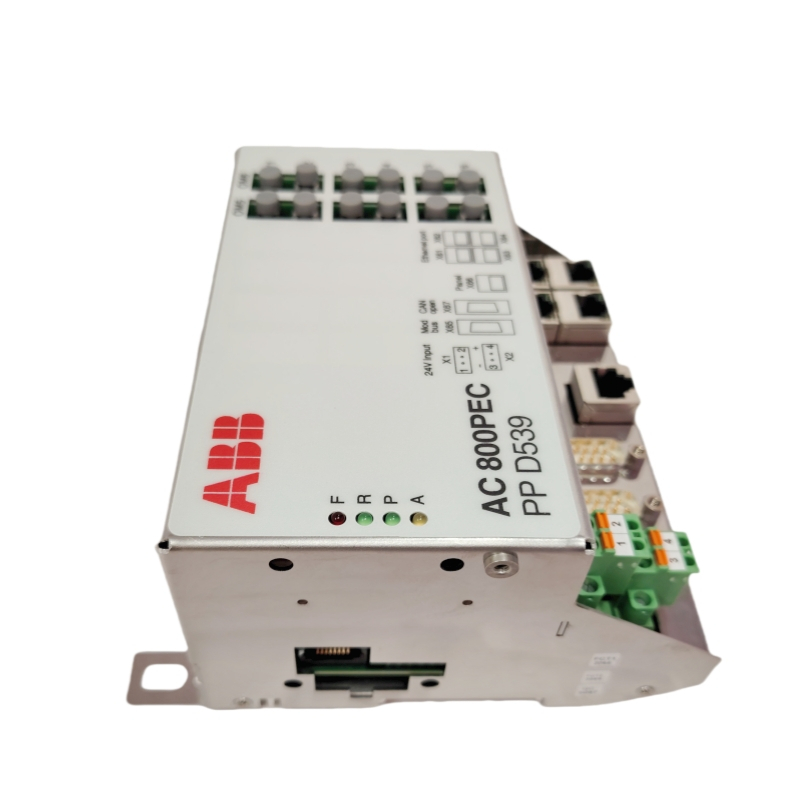

For control engineers and plant maintenance teams, unplanned downtime is the enemy. Every minute of halted production translates to significant financial loss. In the realm of ABB's AC 800M DCS, ensuring the health and availability of core controller modules is a direct line of defense. Today, we're focusing on the ABB PPD539 A102, identified by the precise order code 3BHE039770R0102. This article moves beyond basic description to explore its technical context, failure modes, and strategic importance in a sustainable maintenance program.
Positioning the Module in the AC 800M Architecture
The AC 800M controller is modular. A typical controller rack includes a power supply, a main processor module (like a PM783F), and various extension or communication modules. The PPD539 A102 often serves as a PROFIBUS DP master module or a dedicated communication processor. Its job is to manage a high-speed, deterministic network of field devices—sensors, actuators, motor starters, and variable frequency drives. By offloading this communication traffic from the main CPU, it enhances overall system performance and reliability. Understanding this role is key; when a PROFIBUS network segment fails or becomes unstable, this module is a primary diagnostic point.
Common Symptoms and Failure Analysis
A failing or faulty ABB 3BHE039770R0102 module rarely just "dies" without warning. Operators and engineers might observe:
-
Intermittent Communication Errors: Devices on the associated PROFIBUS network dropping in and out, causing unpredictable process behavior.
-
System Alarms: Specific hardware fault indications in the control system's diagnostic viewer, often pointing to the module's slot or communication channel.
-
Complete Network Loss: A hard failure leading to a total loss of communication with a bank of field devices, potentially triggering a safe shutdown.
-
Status LED Indicators: The module's own diagnostic LEDs (Run, Error, Comm) provide the first visual clue. A solid error light or irregular flashing patterns are clear calls for investigation.
Failures can stem from electrical surges, excessive heat, vibration, or simply age-related wear on electronic components. Notably, issues sometimes perceived as module failure can be caused by network problems (bad terminator, faulty connector) or power supply irregularities.
Strategic Sourcing and Replacement Protocol
When replacement is necessary, a meticulous approach minimizes risk.
-
Exact Match is Crucial: The industry runs on precise part numbers. The 3BHE039770R0102 is that exact fingerprint. Even modules with visually similar PPD539 labels but different suffixes may have firmware or hardware differences that cause compatibility issues.
-
Consider Refurbished for Cost-Effective Reliability: For legacy systems, new-old-stock (NOS) modules can be scarce or prohibitively expensive. A professionally refurbished ABB PPD539 A102 from a certified supplier is a smart alternative. The best refurbishment processes include full testing under load, cleaning, and recertification, often offering performance equal to new at a fraction of the cost.
-
Execute a Controlled Swap: Replacement should follow a strict procedure: back up the controller application, power down the rack (if hot-swap is not supported/verified), swap the module, power up, reload parameters if necessary, and perform comprehensive functional testing of the connected network before resuming full operation.
Beyond Replacement: Integration for Modern Data Access
An advanced perspective on this module involves its role in data accessibility. As a key communication gateway, it holds the data from dozens of field devices. In modernization projects, ensuring its health is also about ensuring a reliable data pipeline for IIoT (Industrial Internet of Things) initiatives. Data from the PROFIBUS network managed by the A102 module can be crucial for condition monitoring, energy management, and advanced analytics platforms.
Ultimately, the ABB 3BHE039770R0102 PPD539 A102 module represents a critical nexus between the digital control world and the physical process. Treating it with technical understanding—from its architecture role to its failure modes and replacement strategy—empowers engineers to not just fix problems, but to build more resilient and data-aware industrial operations. A proactive approach to managing such components is a hallmark of a mature, uptime-focused maintenance culture.
(Image suggestion for both articles: Use a high-quality, clear photo of the actual module, preferably with its label (3BHE039770R0102) visible. Alt-text should be descriptive: "ABB PPD539 A102 industrial automation control module with part number 3BHE039770R0102 visible.")